Problems of the Week for r/physics
This page sucks because we just started.
Send your solutions to the newest puzzles in the linked thread or as PMs to me.
Check out past solutions
Week 1 - Heptagons
Easy
Check out these excellently drawn graphs:
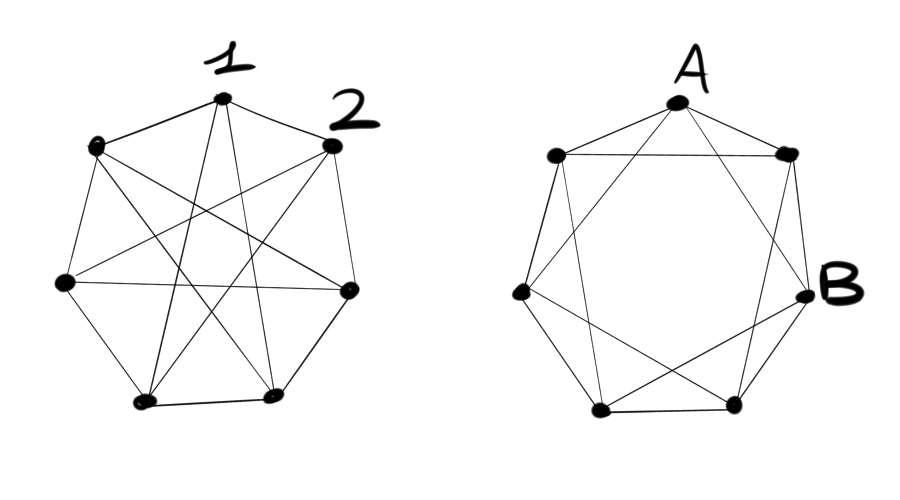
Imagine every line is a humble \(1\Omega\) resistor.
- Prove the resistance between nodes \(1\) and \(2\) is the same as between \(A\) and \(B\)
- Find the resistance.
Hard
Imagine a spaceship capable of relativistic speeds. It accelerates forward with constant proper acceleration \(a\) for a certain (unknown) amount of proper time \(\tau\). When that time has elapsed, it swiftly rotates by \(90^\circ\) left (in its own frame), then again accelerates forward for proper time \(\tau\).
It repeats this ritual \(7\) times, each time accelerating for \(\tau\) and then rotating left \(\pi/2\) degrees. When it's done, it has the same velocity (and orientation) it had originally (with respect to any given inertial frame).
What is the total proper time elapsed?
Hint: replacing \(7\) above with \(n\), the problem is unsolvable for \(n<4\). For \(n=4\), the total proper time is zero.
Week 2 - Balls in general
Winding rope
Take a fixed ball of radius \(R\), and tie one extremity of a rope \(l_0\) long to the bottom. Stretch the rope out horizontally until it's in tension, then attach a little body to the other end, then send the ball moving upwards with speed \(v_0\). As the little ball moves around the bigger, the rope winds around the latter. Ignore gravity and the mass of the rope.
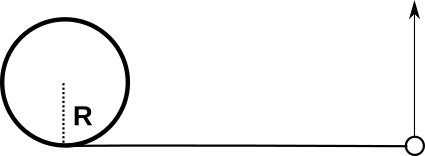
- After how much time do the body and the ball meet?
- How much distance has the small ball flown in that time?
Bubble
Imagine a bizzarre bubble made from a massive membrane with surface tension \(\tau\) and surface mass density \(\mu\), enclosing a perfectly incompressible fluid of negligible density. At equilibrium, the bubble is a sphere of radius \(R\). Work exclusively at leading order in deformations of this shape. Also, ignore longitudinal motion (motion of the membrane parallel to itself).
- Two little seismologists live on the surface of the bubble. They communicate with eachother by oscillating the membrane. What is the maximum speed at which they can send information to eachother this way? Can they send it instantaneously?
- One of them measures the frequency spectrum of a bubble-scale bubblequake with a seismograph. What frequencies can he obtain? What is the lowest possible frequency?
Maximum gravity
this one's a cutie. I don't know where it comes from originally, I've seen it around.
You have a planet of uniform density and given mass. Which shape maximizes the gravitational field at a given point on the surface?
Week 3 - Surreal occurrences
Hairy balls from another dimension
Imagine wind on the surface of the Earth was always parallel to the ground, and assume the wind pattern features no singularities. It famously follows from a ridiculously named theorem that the speed of the wind must vanish at at least one point on the surface. Does this also hold in 4 dimensions? (I.e., if the surface of the Earth was a 3-sphere). If you think so, prove it (you can assume the hairy ball theorem). If you disagree, write down a counterexample in the form of a continuous, tangent wind pattern on the hypersurface of the hyperearth that never vanishes.
Electric cylinder
Take a very long cylinder of uniform fixed positive charge density \(\rho\) and radius \(R\) and imagine there's a uniform magnetic field \(B\) directed along the axis. Imagine sending a positive probe charge with charge/mass ratio \(\frac{q}{m}\) inside the cylinder, with velocity \(\vec v\) orthogonal to the axis and forming an angle \(\theta\) with the surface of the cylinder. Prove the charge always re-exits the cylinder, and find the time it takes from entry to exit as a function of \(\rho\), \(R\), \(B\), \(\frac{q}{m}\), \(v\), \(\theta\).
The actual calculations are kind of messy and not important, so just writing down the procedure for building the closed-form expression for \(t\) as an elementary (i.e. only square roots, polynomials, and trigonometrics allowed) function is also ok.
You lose points if you perform integrals or solve differential equations.
Space worm
A spaceship is thrusting forward with acceleration \(a\). A naive space worm (modeled as an unelastic string of mass density \(\mu\) and length \(l\)) meets heads on with the spaceship with the intent of getting to know her better. The relative speed when they meet is zero. The ship's solar windshield is unimpressed and the worm gets splattered on it segment by segment. The captain doesn't care and increases thrust as to keep the ship's acceleration \(a\) throughout the impact.
- What is the profile of the additional thrust as a function of time?
- With respect to an inertial frame, how much additional energy has the captain expended because of the worm?